
Low voltage landscape lighting in Fort Worth is designed in four steps. The transformer is sized to the total fixture load, and the wire runs are planned so every fixture gets steady voltage. Each fixture is then placed for one clear purpose, and the controls decide when the system runs. The transformer plugs into a GFCI outlet and lowers household power to the low voltage the fixtures use. LED fixtures make each step easier, because they draw far less power than the lamps older systems used. This guide covers each step with guidance from fixture makers, ENERGY STAR and Texas agencies.
What a Low Voltage System Is Made Of
Every system uses the same four parts, whatever the brand.
- Transformer: lowers household power and feeds the cable. Kichler lists common tap settings of 12, 13, 14 and 15 volts.
- Cable: carries power from the transformer to the fixtures. Kichler suggests starting with 12 gauge cable and moving to a heavier wire when a run needs it.
- Fixtures: path lights, spotlights and floods, each with its own beam spread.
- Controls: a photocell, a timer, an app or a motion sensor that turns the lights on and off.
The design work is in how those parts fit one yard. A short front walk and a large backyard with trees use the same parts in very different amounts.
Ellis Landscape Services has served DFW since 2011, and founder Keir Hamlin has 25+ years in the green industry.
Ready to transform your North Texas landscape? Call Ellis Landscape Services at (817) 709-9599 or email info@ellisdfw.com to request your free consultation.
Step 1: Size the Transformer to the Load
Transformer sizing starts with addition. Add up the VA rating of every fixture on the system. Kichler's rule is that the total VA should not exceed the transformer's wattage rating. In its example, a 300 VA system needs a transformer rated at least 300 watts.
Kichler also advises thinking about future expansion when choosing a transformer. A yard that may add patio or tree lights later grows more easily when the first transformer has spare room.
Where the transformer goes
Kichler's installation guidance gives clear placement points:
- Within 8 feet of a standard GFCI outlet.
- At least 12 inches above ground level.
- At least 10 feet from any pool or pond.
- Ideally on its own breaker circuit.
- Wire from the transformer down to the ground runs in gray electrical conduit, buried 6 inches deep.
The pond rule matters in yards with a fountain or pond. Plan the transformer spot before a water feature or patio is built, not after.
Step 2: Plan Wire Runs and Control Voltage Drop
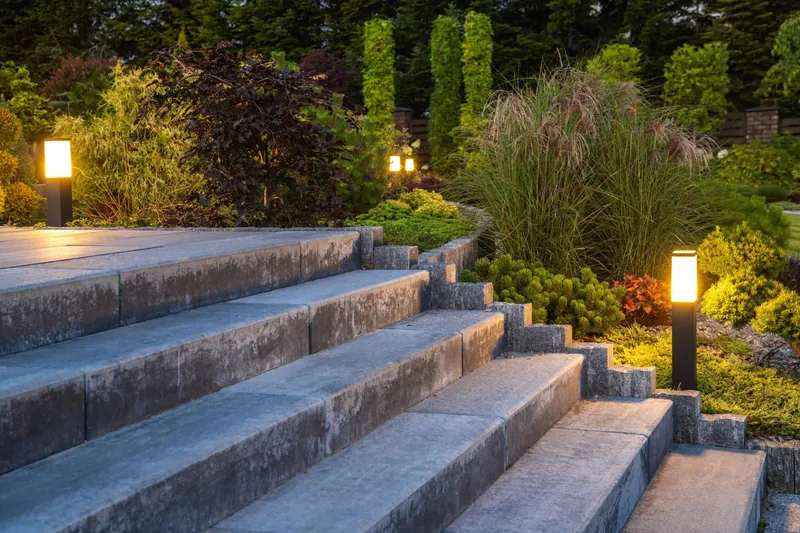
Voltage drop is the main reason a system looks uneven. Power fades along the cable, so the last fixture on a long run can glow dimmer than the first. VOLT Lighting explains that voltage loss depends on wire length, wire gauge and the total wattage on the wire.
Kichler gives a formula for checking each run:
- Voltage drop = (2 x cable length x total VA on the run) / cable constant.
- End fixture voltage = transformer tap voltage minus voltage drop.
- The end fixture voltage should be greater than 10 volts.
The cable constant comes from a chart for each wire gauge. When a run falls short, Kichler suggests moving to a higher tap, taking fixtures off that run or using a heavier wire. A voltmeter reading at the fixtures confirms the math.
Daisy chain, hub or zones
How the cable is laid out changes how even the light looks. The table compares the three common layouts.
| Layout | How it is wired | Effect on the light |
|---|---|---|
| Daisy chain | One wire runs from fixture to fixture, with a splice at each one. | Saves wire, but VOLT warns it can run into trouble with voltage loss, so far fixtures may dim. |
| Hub | Fixture leads meet at one junction, and that junction connects to the transformer. | Equal lead lengths give equal voltage loss, so fixtures get even voltage. |
| Zones | Groups of fixtures are wired as separate units, like rooms in the design. | Each zone can get its own voltage and its own schedule. |
VOLT suggests grouping fixtures that sit within about a 40-foot circle onto one hub. Kichler notes that a plain daisy chain gives no zone control: every fixture is either on or off.
Why LED makes the wiring easier
ENERGY STAR says LED lighting produces light up to 90% more efficiently than incandescent bulbs. Less power per fixture means less total load on each run, and so less voltage drop. LEDs also accept a wider voltage range. VOLT gives 10 to 12 volts for halogen fixtures and 8 to 15 volts for LED. Kichler's check is that fixtures run within 9 to 15 volts.
Ready to transform your North Texas landscape? Call Ellis Landscape Services at (817) 709-9599 or email info@ellisdfw.com to request your free consultation.
Step 3: Fort Worth Outdoor Lighting Design, Fixture by Fixture
Good Fort Worth outdoor lighting design gives every fixture one job. A path, a tree trunk and a stone wall each call for a different fixture and beam. Beam spread is the width of the cone of light. VOLT Lighting's beam guide matches beam angles to targets like this:
| Target | Fixture type | Beam guidance |
|---|---|---|
| Paths and steps | Path light | Staggered on both sides, spaced so the light slightly overlaps. A shade or glare guard keeps light on the ground. |
| Flagpoles, tall slender trees, tall columns | Narrow spotlight | 12 to 17 degrees, with a lower wattage lamp to avoid over-lighting. |
| Columns and trees | Spotlight | 24 degrees. Not for wide, flat surfaces. |
| Smaller trees, wall space between front windows | Flood | 35 to 38 degrees. |
| House facades, plant beds, general coverage | Wide flood | 60 degrees. |
| Long walls, wide retaining walls | Very wide flood | 110 degrees. |
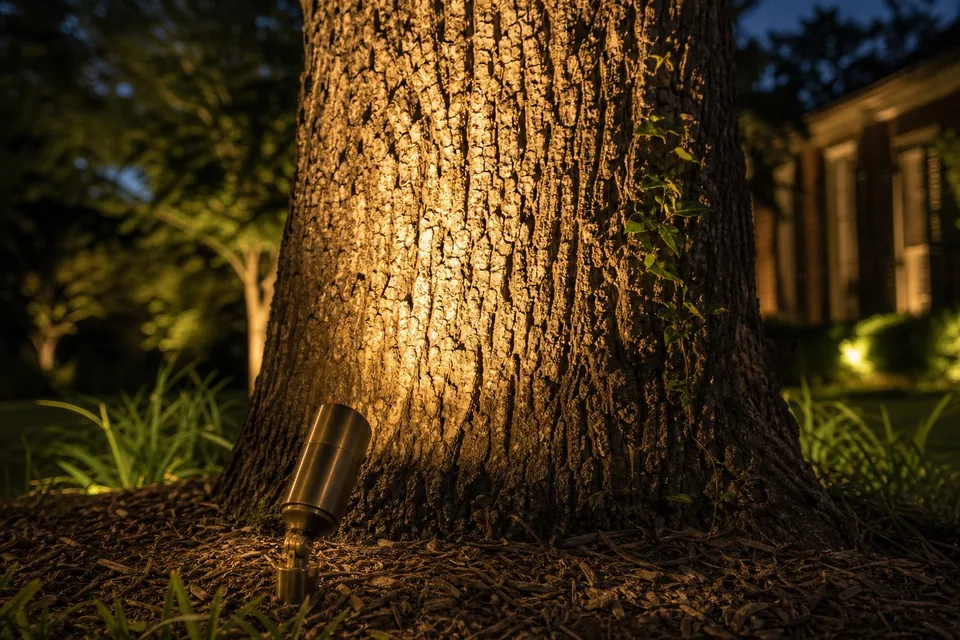
Patios and outdoor rooms work best as their own zone. Kichler lists decks, patios, pergolas, fire pit areas, flower beds, trees and water accents as typical zones. An outdoor living space can then run on its own schedule.
Trees also change through the year. Bare winter branches show a different shape than a summer canopy. The guide to winter landscape lighting ideas for North Texas covers that season.
Step 4: Choose LED Fixtures and Controls
LED landscape lighting in Fort Worth heat
ENERGY STAR explains three LED traits that matter outdoors:
- LEDs rarely burn out. They dim slowly over time, which ENERGY STAR calls lumen depreciation.
- LED lifetime is predicted as the point when light output falls by 30 percent.
- Heat shortens LED life. ENERGY STAR calls thermal management the single most important factor in LED performance.
That last point matters for LED landscape lighting in Fort Worth, where fixtures sit in summer sun for months. Ask how a fixture handles heat before choosing it. LEDs are also directional, so they send light where a fixture is aimed.
Photocell, timer, app or motion sensor
Controls decide when the lights run. Each type suits a different use.
| Control | How it works | Best fit |
|---|---|---|
| Photocell | Senses daylight and runs the lights from dusk to dawn. | All-night lighting. Kichler calls it a good choice where Wi-Fi is not available. |
| Mechanical or digital timer | Runs on set clock times. | Lights that come on in the evening and go off after a few hours. No internet needed. |
| App or Wi-Fi control | A smart transformer or timer run from a phone app. | Owners who want app or voice control. Kichler's smart transformer adds power monitoring and fault detection. |
| Motion sensor | Turns light on when someone is present. | Entries and side yards. Entergy says a combined photocell and motion sensor saves even more energy. |
Seasonal lights can sit on top of a permanent system. See holiday lighting vs permanent outdoor lighting for that choice.
Texas Rules Before Anyone Digs in a Fort Worth Yard
Landscape lighting cable goes in the ground, so the digging rules apply. These are the checks for a Tarrant County property:
- Call 811 first. The Railroad Commission of Texas says homeowners, excavators and contractors are required by law to call 811 at least two days before digging. The call is free. Locators mark buried lines with flags or paint, and the marks show approximate locations.
- Licensing. TDLR says landscapers who work on low-voltage exterior lighting, excluding power sources, do not need a state electrician license. Homeowners working on a home they own and live in are also exempt. TDLR adds that municipal or regional rules may override these exemptions.
- City permits. The City of Fort Worth takes electrical permit applications online through its Accela Citizen Access portal. Its permits page does not mention low voltage or landscape lighting.
The safe path is simple. Call 811 before any trench, and ask the city about permits when a project adds a new outlet or circuit. The state exemption covers the low voltage side, not the power source that feeds it.
Questions to Ask Any Fort Worth Landscape Lighting Service
A clear plan answers these before work starts. The list works with any installer, Ellis included.
- What is the total VA of all fixtures, and what is the transformer rating?
- Where will the transformer sit, and how far is it from the outlet and any pond or pool?
- Is the cable laid out as a daisy chain, on hubs or in zones?
- What voltage is expected at the last fixture on each run, and will it be checked with a voltmeter?
- What is each fixture lighting, and what beam spread does it use?
- Which control runs each zone: photocell, timer, app or motion sensor?
- Has 811 been called, and does the project need a city permit?
Common Questions About Low Voltage Lighting
How big a transformer does a yard need?
Add the VA of every fixture. Kichler says the total should not exceed the transformer's wattage rating. Leave room if more lights may come later.
Why are the last lights on a run dimmer?
That is voltage drop. Long runs, thin wire and heavy loads all lower the voltage that reaches the far fixtures. Hub wiring, a higher tap or heavier cable can fix it.
Does a low voltage system need an electrician in Texas?
TDLR exempts landscapers working on low-voltage exterior lighting, excluding power sources, from state electrician licensing. Local rules may override that, so check with the city.
Is LED worth it for landscape lighting?
ENERGY STAR says LEDs make light up to 90% more efficiently than incandescent bulbs. They also dim slowly instead of burning out.
Planning a System With Ellis
Ellis Landscape Services designs and installs landscape lighting across Tarrant County and western DFW, from Fort Worth and Keller to Southlake and Trophy Club. Every property is different, so there are no flat prices. A free consultation is the first step.
Ellis is licensed and insured and has served DFW since 2011. Founder Keir Hamlin holds TCEQ Licensed Irrigator #20021.
Ready to transform your North Texas landscape? Call Ellis Landscape Services at (817) 709-9599 or email info@ellisdfw.com to request your free consultation.